
Every claims manager has a folder of claims they paid while privately believing they shouldn’t have. A customer reports four cartons short on a pallet your team swears left full, a supplier insists the crushed corner happened on your dock, and with no record of what the freight looked like when it moved, the cheapest move is usually to pay, note it as damage, and get back to the queue. Do that enough times and the problem stops being the money, since the damage rate on the monthly report now includes losses that may never have happened, the carriers you dispute with have learned you rarely push back, and the real claims sitting in the same pile get the same skeptical read as the fake ones. When roughly a third of claims filed are fraudulent, the hardest part of claims work becomes proving which third you’re looking at.
What counts as a fraudulent freight claim?
A fraudulent freight claim is an OS&D claim for a shortage, overage, or damage that didn’t happen where, when, or how the claimant says it did. Some are deliberate, like a consignee reporting cartons short that were received and put away, or a value inflated well past what the goods were worth. Many are opportunistic, like damage that happened at the customer’s own facility getting reported as transit damage, or a concealed damage claim filed weeks later on freight that was signed for clean. The common thread is that every one of them depends on nobody being able to show what the shipment actually looked like at the moment it changed hands, which is exactly the gap most OS&D processes leave open.
What does manual receiving inspection actually catch?
Manual receiving inspection catches only the damage a receiver happens to see while scanning, counting, and moving freight at the same time. On a heavy day that’s a lot less than anyone would like, since damage on the far side of a pallet goes unseen, concealed damage under shrink wrap gets signed for as clean, and OS&D notes often get written from memory at the end of a shift, so when a dispute shows up weeks later the team is rebuilding receiving conditions from fragments. Roughly 30% of freight claims filed industry-wide are fraudulent, and without a real record at receiving, a 3PL has no good way to separate the legitimate claims from the opportunistic ones sitting right beside them.
Why does a 30% fraud rate make every claim harder to win?
A 30% fraud rate makes every claim harder to win because the party reviewing it has to assume any given claim could be one of the fake ones. Roughly 30% of freight claims filed industry-wide are fraudulent, and the wider freight fraud problem is large enough that ATRI puts its cost to U.S. transportation at $6.6 billion a year, according to Inbound Logistics. Carriers and customers price that suspicion into every review, so claims backed only by a signed bill of lading and a few phone photos tend to get denied, sent back for more documentation, or settled for a fraction of their value, and every round of back-and-forth adds to a manual claims cycle that already runs 12 to 15 hours. The warehouse filing a legitimate claim pays for everyone else’s fraud in time and in recovery.
Why don’t claims teams trust their own numbers?
Claims teams don’t trust their own numbers because the claims they pay to avoid a fight get recorded as real warehouse damage claims. When one of the small shortage claims that come in every week would take half a day to contest, paying it is often the rational call, but every one of those payouts lands in the damage and OS&D totals as if the loss happened on your floor. Over a quarter that inflates the damage rate, points root-cause work at stations and shifts that may be fine, and makes it hard to tell whether a new process is working, which matters because shipment inaccuracies, damage, and compliance issues can cost warehouses up to 10% of revenue and nobody can fix a loss they can’t measure cleanly. The same blind spot runs the other way, too, because inbound shortages and damage that should have been charged back to a supplier or carrier get absorbed as shrink when there’s no record from receiving to support the claim.
Where does claims fraud hide in a warehouse?
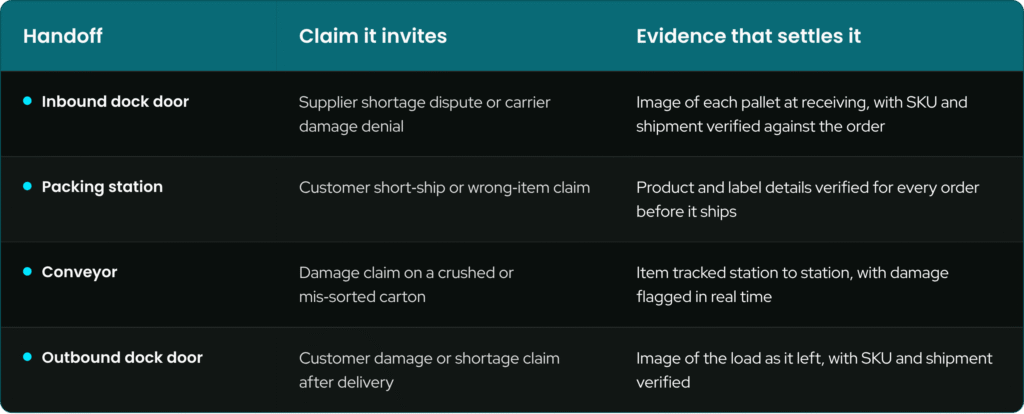
Claims fraud hides at every handoff where a shipment’s condition changes ownership without a record, which in most warehouses means the dock door on the way in and the packing station and dock door on the way out. On inbound freight, supplier disputes and carrier claims get hard to win when the receiving team has nothing beyond a signature, and on outbound freight, a customer can report a short ship or damaged carton that left the building complete and intact. A 3PL running multiple client programs carries both exposures at once, which is why so many disputes end up landing on the 3PL, as covered in AI shipment inspection for 3PL receiving.
What does it take to tell a real claim from a fraudulent one?
Telling a real claim from a fraudulent one takes condition evidence tied to a specific shipment, station, and moment, captured before anyone has a reason to argue. That means an image of the pallet or carton as it crossed the dock door, where most outbound shipping errors start, verification that the SKUs and counts matched the order before it shipped, and a record that connects both to the shipment ID in the WMS, so pulling it later takes a search instead of a scavenger hunt. Evidence gathered after the claim arrives is always weaker, because by then the freight has moved, the footage has to be found by hand, and the claimant knows exactly what you’re looking for. With a record captured at the source, freight claims management gets a lot simpler, since a fraudulent claim tends to fall apart on the first reply, and a real claim goes in with the proof it needs to recover.
From suspect to settled
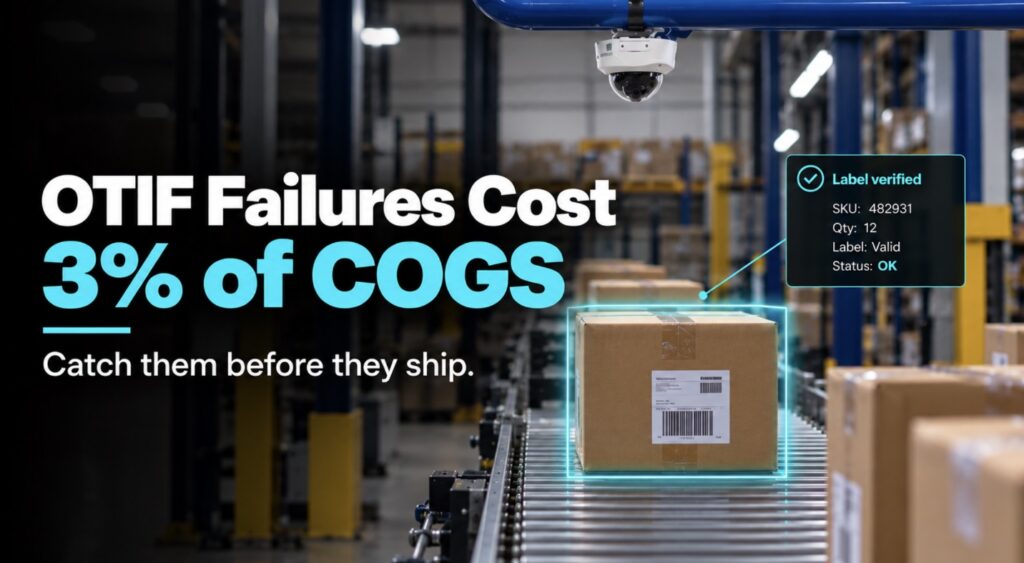
Arvist is a vision AI platform that records shipment condition at packing, conveyor, staging, and dock door stations using cameras, so every claim can be checked against what the freight actually looked like when it moved. At the packing station, Arvist verifies order accuracy before a carton ships, reading product and label details and catching mis-picks and short-ships before they leave the building, and at the dock door, Arvist verifies SKU and shipment details on inbound and outbound freight and catches damage before it’s loaded or received. Each record ties back to the shipment through 80+ WMS and ERP integrations, so the evidence for a claim is already attached to the order it belongs to.
Arvist Claims Management extends that same quality control layer into the claim itself, working in both directions. On outbound claims, Arvist pulls the station evidence and drafts the response for a person to review, so a fraudulent short-ship or damage claim gets answered with the load verification record of what actually left the dock. On inbound shipments, a claim against a supplier or carrier can be started straight from the receiving inspection, pre-filled with order data and evidence, so losses that used to get written off as shrink get recovered instead. Arvist Claims Management cuts claims processing from 12 to 15 hours to about 3 minutes, and Arvist customers see 35% fewer damage claims.
The bigger shift is that the claims numbers start meaning something again. When fraudulent claims get closed on the first reply and real ones go in with the evidence attached, the damage rate on the monthly report reflects what happened on the floor, and the team can finally go after the root causes that are real. Arvist deploys with zero change management and no downtime, so receivers and packers keep working the way they already do from day one.
Frequently asked questions
What is a fraudulent freight claim?
Roughly 30% of freight claims filed industry-wide are fraudulent, which is why carriers and customers review even legitimate claims with suspicion.
Is a fraudulent freight claim the same as freight fraud?
Freight fraud usually refers to schemes like fictitious pickups and carrier impersonation, while a fraudulent freight claim is a false or inflated OS&D claim on freight that was actually delivered or received.
What evidence do you need to win a freight claim?
Winning a freight claim takes the bill of lading, the delivery receipt with any exceptions noted, and visual evidence of the shipment’s condition tied to a specific station and time, such as a dock door image of the pallet as it was received or loaded.
How does Arvist help with fraudulent freight claims?
Arvist uses vision AI at packing, conveyor, and dock door stations to record shipment condition automatically, and Arvist Claims Management attaches that evidence to the claim, cutting claims processing from 12 to 15 hours to about 3 minutes.
Does Arvist Claims Management cover inbound claims?
Arvist Claims Management covers inbound shipments as well as outbound claims defense, so a claim against a supplier or carrier can start from the receiving inspection, pre-filled with order data and evidence.