Outbound Shipping Errors Don’t Start in Transit. They Start at the Dock.
The gap in outbound dock verification is quieter than you’d expect — and more expensive than most operations realize. Here’s what’s actually happening at the dock door, and how modern load verification closes it before the truck rolls out.
In this article:
° Why outbound shipping errors are so hard to catch at the dock door in real time
° What a mislabeled pallet or misloaded trailer actually costs downstream
° How traditional verification methods fail under real warehouse conditions
° How Arvist’s camera-based Dock Door Load Verification system closes the gap with automated, real-time inspection
° What it looks like when the dock door becomes a genuine control point instead of a throughput risk
If you’ve ever been on the receiving end of an outbound shipping error — the customer call, the carrier dispute, the internal scramble to figure out what actually left the building and when — you already understand the particular frustration of a problem that was invisible until it was expensive. Somewhere between the pick, the stage, and the load, something went wrong. The wrong pallet went through the wrong door, or a complete shipment left incomplete, or a damaged unit made it onto the trailer because nobody was in a position to catch it in the 30 seconds it took to move through the dock. Nobody intended for it to happen. In the moment, nobody noticed. The dock kept moving, the next trailer pulled in, and the day carried on like nothing had.
The problem with outbound errors at the dock door is that they’re almost always invisible until they’re not. They don’t surface when the pallet is loaded. They surface when the customer receives the wrong item, when a carrier dispute lands with no documentation to back up your version of events, when an OSD claim arrives and the investigation traces back to a shipment that left three days ago without proper verification. By the time the cost is visible, the window to prevent it has been closed for days. What’s left is the expensive, time-consuming work of figuring out what happened and who absorbs the fallout.
That gap between what happens at the dock door and what it costs you downstream is something most warehouse operations have learned to manage around rather than actually solve. Not because operations leaders don’t take it seriously — they do. But the tools built for outbound verification were never really designed to close it. They were designed to move shipments quickly, and when accuracy competed with throughput, accuracy is usually lost.
In a conventional outbound operation, the last verification checkpoint before a trailer departs falls on whoever is working the dock. That might mean a forklift driver scanning barcodes and cross-referencing a manifest, or a supervisor doing a visual walk of the load before the door goes down. On well-staffed shifts with straightforward loads, it works well enough. But warehouses aren’t defined by their well-staffed shifts and straightforward loads.
They’re defined by their hard days — the ones where three trucks arrive in the same window, the team is two people short, and every decision is being made under the pressure of a clock that doesn’t care about any of it.
Under those conditions, the verification step is exactly the kind of thing that gets abbreviated. Not because the team doesn’t know it matters, but because something has to give and the truck is waiting. A barcode gets scanned without being fully cross-checked against the WMS. A visual inspection covers the front of the load but not the sides. A pallet moves through the dock door while the operator is managing something else and the system never sees it at all. None of this happens because people aren’t trying. It happens because manual verification was always dependent on attention and availability, and those are exactly the resources that run out fastest when the dock is under pressure.
The downstream consequences are familiar to anyone who has managed outbound operations through a busy stretch. Wrong loads discovered after departure mean emergency re-ships and carrier coordination that consumes hours of management time. Incomplete shipments that reach the customer trigger disputes that are nearly impossible to resolve without documentation of what actually left the dock. Damaged goods that were loaded without detection travel the full distance to the customer before the problem surfaces, turning what could have been a two-minute catch at the dock into a return, a complaint, and a customer relationship that takes months to repair. And underneath all of it sits a persistent uncertainty about what’s actually leaving the building and whether the WMS reflects what really happened. When verification is inconsistent, inventory accuracy erodes quietly in the background, accumulating errors that eventually surface in cycle counts, reorder miscalculations, and fulfillment discrepancies that nobody can immediately explain.
Arvist’s Dock Door Load Verification solution is a purpose-built, camera-based inspection system designed specifically for the outbound dock door. It arrives as a fully packaged, ready-to-install kit that requires only power and network connectivity — deployment typically completes in under 48 hours, with no complex infrastructure work or extended IT involvement. If your team has lived through how long traditional automation projects can drag, that timeline will feel notable.
The system is installed directly above dock doors and uses a network of 5 to 6 industrial cameras configured to provide complete visual coverage of all goods as they move through the door and onto the trailer. The camera arrangement is built around the specific problem of pallet verification at the dock. Every key angle is covered: front, top, and both sides of each pallet. That matters because label placement and damage don’t always present in the same orientation, and a single camera will reliably miss both. Multi-angle coverage is what makes it possible to read labels accurately regardless of how a pallet is oriented as it crosses the threshold, and to detect visible damage consistently across surfaces that a less comprehensive setup would leave blind.
Motion detection and controlled lighting trigger an inspection automatically as each pallet passes through the door. The system doesn’t wait for an operator to initiate anything. It doesn’t depend on someone remembering to open a workflow before the next truck arrives. It simply runs — for every pallet, every time, under every condition, including the conditions where every previous version of this process was most likely to fail.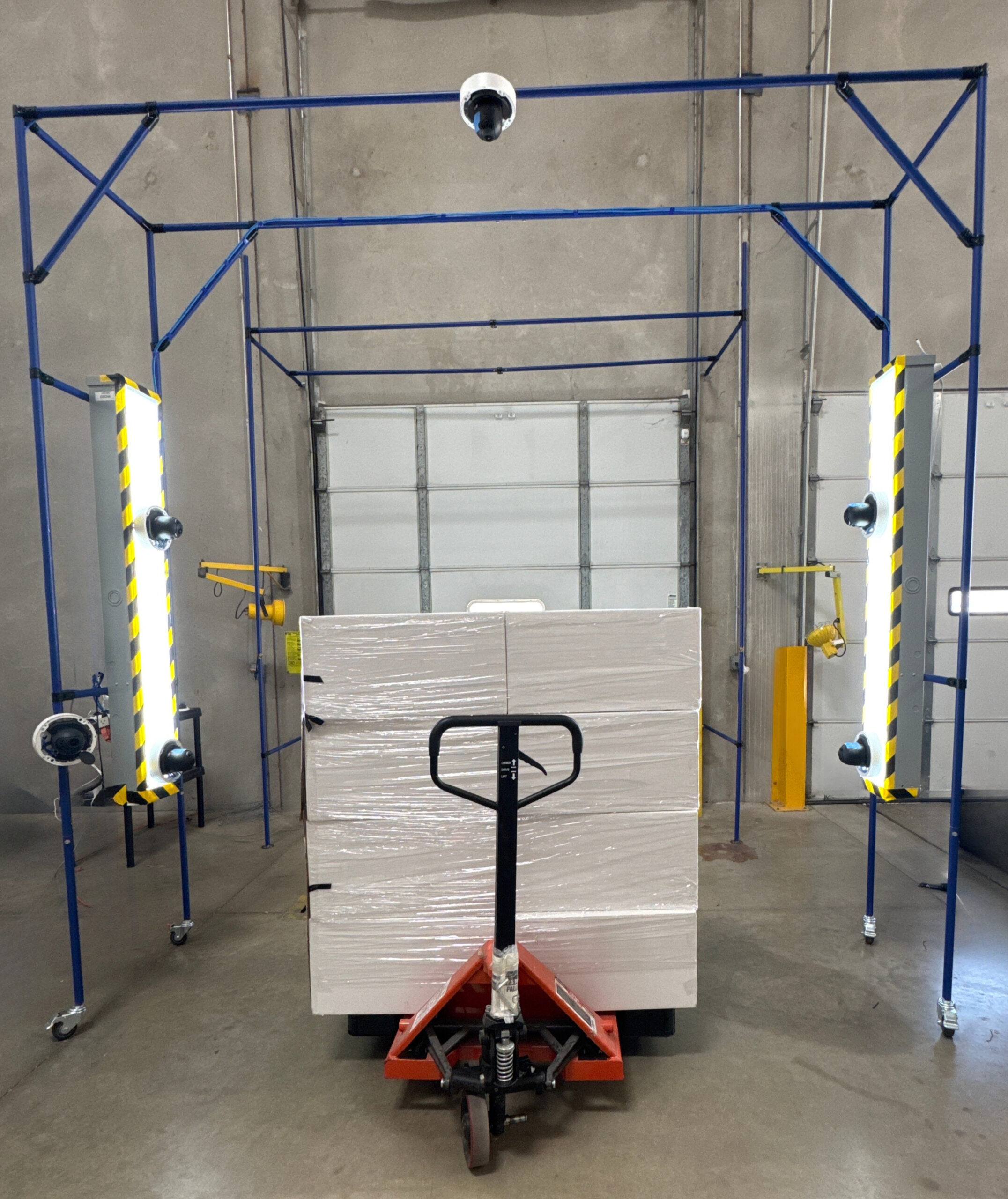
What distinguishes Arvist’s approach from conventional dock monitoring isn’t just what it captures. It’s when the capture translates into action. The system performs deep visual analysis on every pallet as it moves through the door: reading shipment labels, order numbers, and LPN pallet IDs; scanning both text-based labels and 2D barcodes; detecting visible damage across pallet surfaces before anything makes it onto the trailer. That data is instantly cross-referenced against WMS or ERP records to validate three things at once — whether the correct shipments are being loaded, whether all required pallets for that shipment are accounted for, and whether each load is staged at the dock door it was actually assigned to.
If something doesn’t match — a pallet routed through the wrong door, a shipment missing a unit, a load that doesn’t reconcile with the bill of lading — the system triggers real-time visual alerts and operator notifications while the situation is still correctable. The window to intervene hasn’t closed. The truck hasn’t left. The error doesn’t ship.
That timing is everything in outbound dock verification. Catching a mislabeled pallet at the dock door is a two-minute problem. Catching it after the truck has been on the road for four hours is a two-day problem with a significantly larger invoice attached. The severity of the original error is the same in both scenarios. What changes is entirely when the detection happened.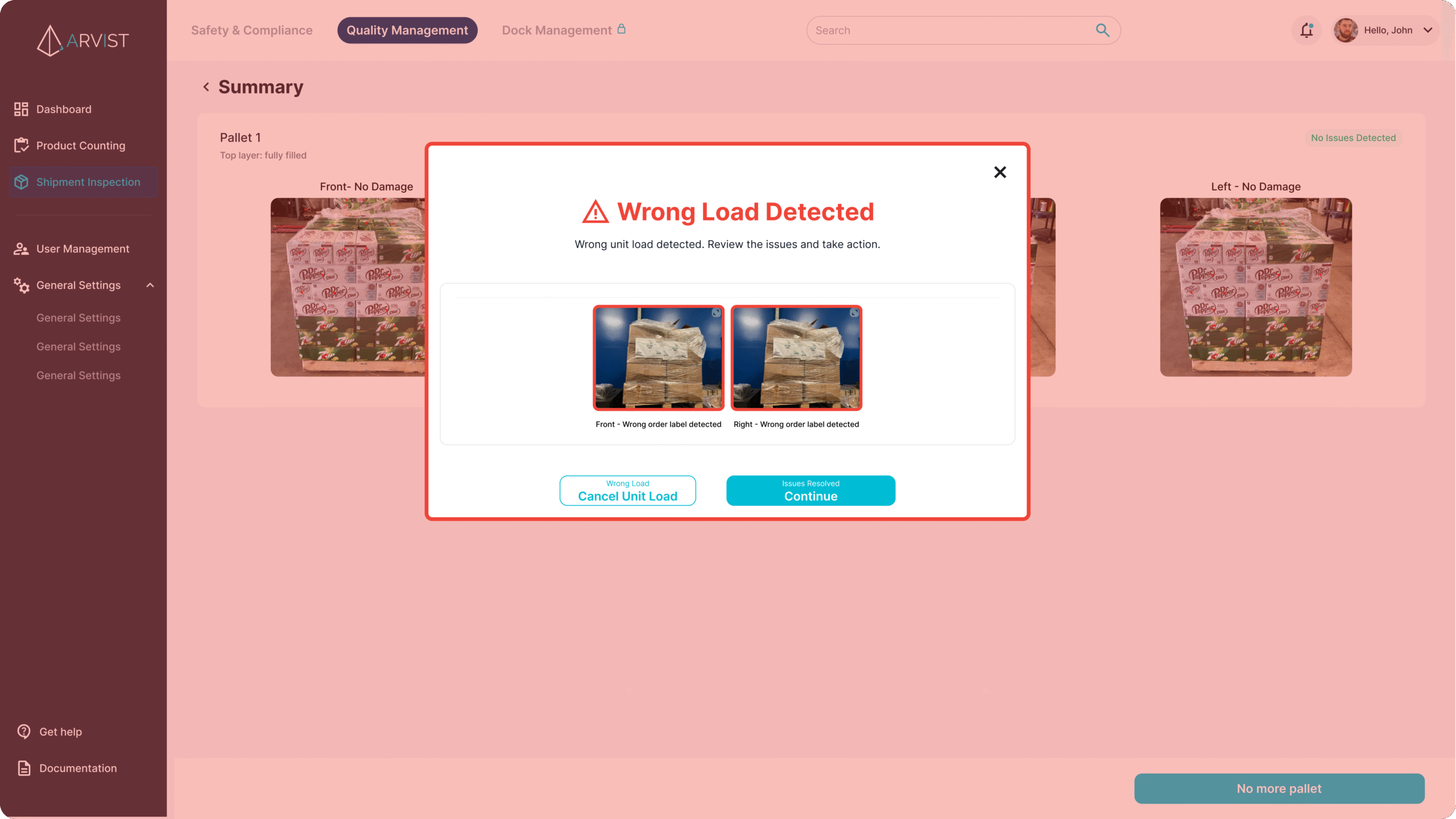
One of the more consequential design decisions in Arvist’s dock door solution is where the processing happens. All video footage and inspection data are analyzed locally, on-premises, without being transmitted to the cloud. For operations leaders who have dealt with the latency problems that come with cloud-dependent systems trying to make real-time decisions, that architecture choice makes immediate sense.
Real-time dock verification requires processing that isn’t subject to network variability. When the inspection depends on a round trip to a remote server, the gap between detection and alert grows to exactly the length of that round trip. In the context of a pallet moving through a dock door at operational speed, that’s often the gap where an error clears the threshold before anyone knows to stop it. Local processing removes that variable entirely.
Processing on-premises also means that inspection accuracy doesn’t fluctuate with network conditions. In a large warehouse environment with significant wireless congestion, degraded connectivity isn’t a hypothetical — it’s a regular occurrence. On-premise processing holds under those conditions the same way it holds on a clean network day, because the dock doesn’t adjust its pace for infrastructure problems and the verification system shouldn’t either.
The security advantages reinforce the performance case. Shipment records, loading footage, and operational data stay within the facility’s network perimeter. There are no continuous data flows to external servers, no exposure surface created by sending sensitive operational footage offsite, and no dependency on external cloud availability for core system function. For organizations operating under customer data agreements or regulatory requirements around footage handling, on-premise architecture often isn’t a preference — it’s a requirement.
For operations that want redundancy or centralized visibility across multiple facilities, an optional cloud backup storage layer is available and fully configurable. It’s not required for the system to operate.
Every inspection the system runs is fully documented. High-resolution images and video recordings of the loading process are automatically captured and linked to the corresponding shipment, dock door assignment, and timestamp. The result is a complete, retrievable record of every outbound load — not a log entry or a summary, but actual visual evidence of what was loaded, when, and in what condition.
When an OSD claim arrives, the evidence is ready in minutes. When a carrier disputes the condition of a load, there’s objective documentation of what left the dock. When a customer insists a shipment arrived incomplete, there’s a timestamped record of every pallet that moved through the door. Disputes that previously required extended negotiation or split-cost concessions — because neither side had adequate documentation — can now be resolved quickly and with confidence, because one side has a clear visual record and the other doesn’t.
For operations handling high shipment volumes, or working with carriers and retail partners who file frequent OSD claims, this audit capability isn’t a secondary benefit. It’s a meaningful operational asset that pays for itself in the first handful of disputes it resolves.
The efficiency gains from automated dock door load verification are real, but the deeper value is harder to put on a spreadsheet and more important to understand. It’s the difference between a warehouse that discovers outbound errors and investigates them after the fact, and one that structurally prevents them from leaving in the first place.
In an operation without reliable outbound verification, problems surface downstream and get resolved through investigation. Someone notices the discrepancy, traces it back through the records, figures out where the process broke down, and moves on until the next one appears. That cycle absorbs enormous amounts of labor and management attention, and it never addresses the structural issue, because the structural issue is a gap in the process. Gaps get exploited on hard days, which means the problems keep coming regardless of how well the team performs.
Closing that gap at the dock door changes the dynamic at its root. Shipments don’t slip through because there is no longer a point in the process where they can clear unverified. Problems that used to surface in customer complaints and carrier disputes get caught while they’re still cheap and simple to fix, before they’ve traveled downstream and picked up additional costs along the way. Investigation cycles get shorter because there’s less to investigate. The firefighting slows down because fewer fires are starting — not because the team got better at responding to them, but because the process that was generating them has been structurally corrected.
That shift compounds over time. Every mislabeled pallet caught at the dock is a carrier dispute that never opens. Every incomplete shipment flagged before departure is a customer complaint that never arrives. Every piece of damage detected before loading is a return that never needs to be processed. The benefit isn’t only in the individual errors prevented. It’s in the cumulative effect of a process that holds consistently across every shift, every load, and every truck — without requiring the dock to have a perfect day in order to perform like one.
Want to see how it works in a live warehouse environment? Visit the Load Verification use case page for a closer look at the solution, or book a visit to the Arvist Experience Center in Chicago — it’s running on an actual warehouse floor, not a demo stage.