Ask anyone who runs receiving at a 3PL what happens when a shipper client calls about a short pallet or a crushed carton, and the answer usually comes back as a story about digging. Someone pulls the signed delivery receipt, someone else checks whether the receiver made a note, and then the team goes looking for a photo that may or may not exist, all while the client is already treating the loss as yours. What makes this so frustrating is that the freight arrived in whatever condition it arrived in, and the truth of that was settled the moment it crossed the dock door, so the hours spent afterward are really spent trying to recover a record nobody captured. Most of what goes wrong in a receiving dispute happens long before anyone files anything, in the few seconds when the shipment was received and nobody wrote down what it looked like.
Why do receiving disputes end up as the 3PL’s cost?
Receiving disputes end up as the 3PL’s cost when the 3PL can’t prove what condition the freight was in when it arrived. If a shipper client says a pallet came in short or a carton left their facility intact, and the receiving team has nothing beyond a signed delivery receipt, the 3PL often absorbs the chargeback to protect the account, since arguing without evidence tends to cost more in goodwill than the claim itself. Carrier claims follow the same pattern from the other direction, because once a damaged carton crosses the dock door without a noted exception, the carrier has a strong argument that it left their hands in good shape.
What does manual receiving inspection actually catch?
Manual receiving inspection catches only the damage a receiver happens to see while scanning, counting, and moving freight at the same time. On a heavy day that’s a lot less than anyone would like, since damage on the far side of a pallet goes unseen, concealed damage under shrink wrap gets signed for as clean, and OS&D notes often get written from memory at the end of a shift, so when a dispute shows up weeks later the team is rebuilding receiving conditions from fragments. Roughly 30% of freight claims filed industry-wide are fraudulent, and without a real record at receiving, a 3PL has no good way to separate the legitimate claims from the opportunistic ones sitting right beside them.
What are AI warehouse inspection tools?
AI warehouse inspection tools use cameras and vision AI to inspect shipments automatically, recording their condition and flagging damage or discrepancies as freight moves through the warehouse. Receiving is a natural place to apply artificial intelligence for logistics, because every inbound pallet and carton gets captured at the dock door, compared against what the shipment was supposed to contain, and kept as a timestamped visual record. The practical shift is coverage, since automated warehouse inspections run on every shipment at full dock speed, so the record exists for the freight nobody expected to be a problem as well as the freight that obviously was.
What should 3PLs look for in warehouse inspection software?
3PLs should look for warehouse inspection software that captures every inbound shipment automatically and ties each image to the right shipment and client. Verification against the expected SKU and shipment details matters too, and the client piece matters more for third-party logistics technology than almost anywhere else, because a multi-client operation needs the evidence to land in the right customer’s record without someone sorting it by hand, which makes integration with the WMS or ERP in use a deciding factor. It’s also worth asking whether the system follows freight past receiving, since a dispute about an outbound order is a lot easier to settle when the same record covers the shipment from the moment it came in to the moment it left.
From signed for to on file
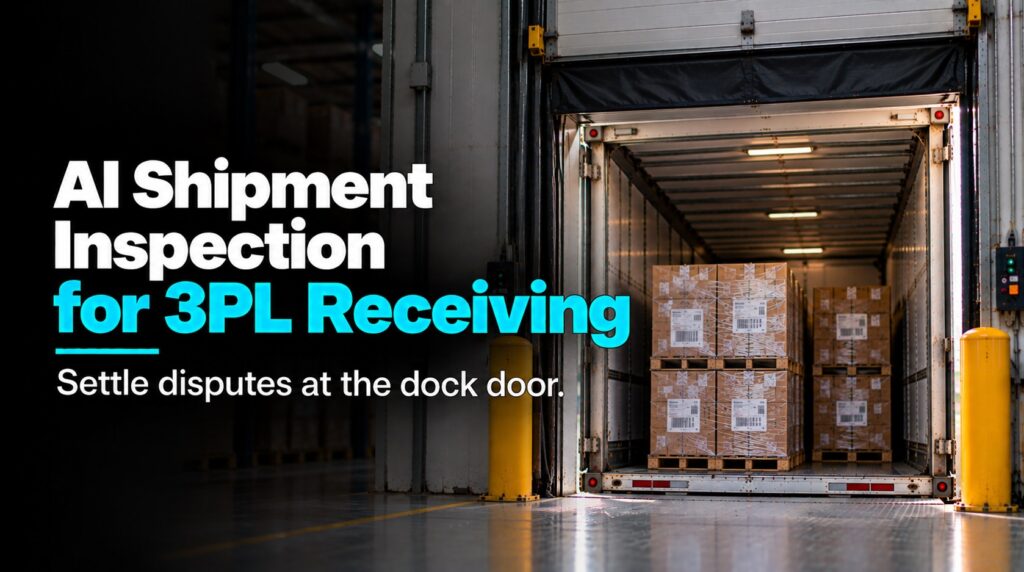
Arvist is a vision AI platform that inspects inbound shipments at the 3PL dock door, verifying SKU and shipment details automatically and catching damage before freight is received. Arvist covers inbound and outbound at every door, so the evidence a dispute needs gets captured in the moment instead of reconstructed three weeks later when a client finally calls. Because the same quality control layer extends to packing, conveyor, and staging stations, a 3PL can follow a shipment through the whole building, and Arvist Claims Management builds on that same evidence to cut claims processing from 12 to 15 hours to about 3 minutes.
The difference shows up in how few disputes go anywhere at all, since a claim with clear visual proof attached tends to get settled quickly in one direction or the other, which is a big part of why Arvist customers see 35% fewer damage claims. Arvist also deploys with zero change management, no infrastructure refresh, and no downtime, so receivers keep working exactly the way they already do from day one, covering every dock door at a site is realistic from the start.
Frequently asked questions
What is AI shipment inspection?
AI shipment inspection uses cameras and vision AI to record the condition of every shipment automatically, detect damage and discrepancies as freight is received, and keep timestamped visual proof for OS&D reporting and freight claims.
How is AI warehouse inspection different from scanning barcodes at receiving?
A barcode scan confirms that a shipment arrived, while AI warehouse inspection also records what condition it arrived in, and Arvist verifies SKU and shipment details and captures damage at the dock door in the same pass.
Can AI inspection catch concealed damage?
Arvist flags visible damage to pallets and cartons as freight is received, and the timestamped dock door images give a 3PL a clear baseline to compare against if concealed damage gets reported later.
Does Arvist work for multi-client 3PL warehouses?
Arvist works for multi-client 3PL warehouses through 80+ WMS and ERP integrations, so inspection records attach to the right shipment and the right client, which keeps 3PL warehouse management clean across accounts.
Which warehouse areas does Arvist cover?
Arvist covers dock doors for inbound and outbound shipments, along with packing, conveyor, and staging stations, so a shipment can be followed from receiving through to the outbound door.
What is OS&D and how does it relate to receiving disputes?
OS&D stands for overage, shortage, and damage, and these are the receiving discrepancies that most often turn into client chargebacks and carrier claims when they aren’t documented at the dock door.
Do receivers have to change how they work?
Receivers keep their current process from day one, because Arvist deploys with zero change management and no downtime.