
Every November, the same thing happens on warehouse floors across the US. Volume doubles, temporary staff join, new lines go up, and the tolerance for mistakes drops to zero.
Peak rarely creates new OS&D problems. It exposes the ones a process could quietly absorb in a normal month: the extra scan, the alert nobody had time to read, the inspection flow that fit one load type but not the next.
As head of product at Arvist, I spend much of this season looking at how our 3PL customers run their floors. Here are three lessons from their operations, and what we built because of them.
Lesson 1: At peak volume, the scan is the bottleneck
On a pack line, every second per order is multiplied across thousands of orders a day. In a scan-based process, the packer picks up each item, finds its barcode, scans it and moves on to the next. Items with no barcode, a damaged label or a label facing down stop the flow completely.
At peak, that friction sets the line’s speed limit. It is also where overages, shortages and wrong items slip through, only to surface weeks later as claims.
So we removed the scan. Our scanless pack table uses computer vision to identify every product placed on the table. Each client’s product catalog is turned into visual embeddings, a compact fingerprint of what each product looks like. The system recognizes items by appearance, including products with no label or barcode at all, and tells look-alike variants apart.
The result: verifying all the items in an order takes under 2 seconds, compared with around 25 seconds when each item is scanned. The packer places the items, the cameras check them against the order, and any shortage, overage or wrong product is flagged before the box is closed.
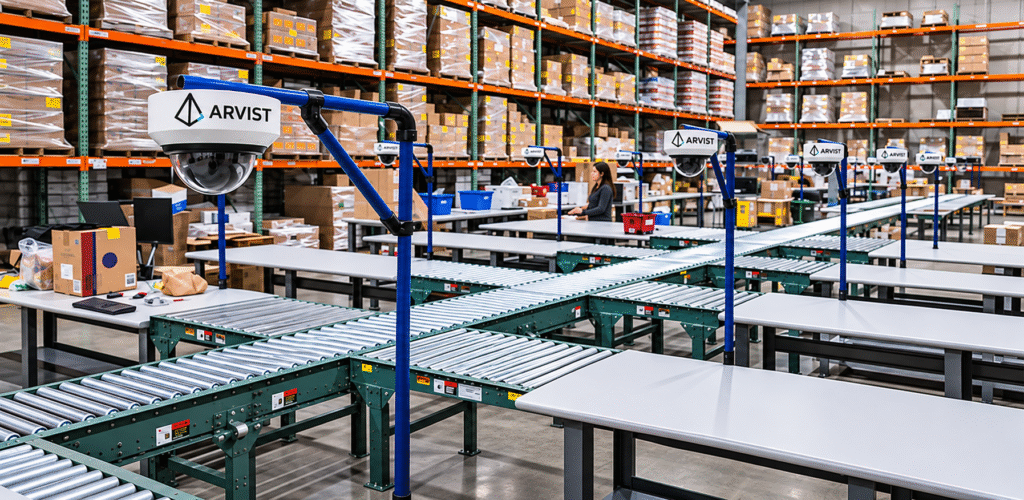
That is why the line in the photo above was built with an Arvist camera over every pack table. When this customer scaled its pack-out capacity for peak, inspection was designed into the line from day one, not added later.
Lesson 2: OS&D gets resolved where the operator stands, or not at all
Detection is only half of OS&D. An alert that sits on a desktop screen while the line keeps moving gets resolved hours later, or never. By then, the pallet is already on a truck.
So we rebuilt exception handling around the person on the floor. The Arvist Tablet App is a tablet-first app built for the station: one task at a time, large touch targets that work with gloves, and nothing that belongs in an office.
When a shortage, overage, wrong product or damaged unit is detected, the alert opens right at the station, with the image and the action to take. The operator confirms the missing item was added, removes the extra unit, assigns the right product or cancels the load, and moves on.
Two smaller details matter more at peak than they seem:
- Operators see “good”, not only “bad”. Each pallet shows a load status, from “Verifying” to “Load verified” or “Wrong load”. When you move fast, silence is not reassuring.
- The live view stays clean, and the record stays complete. When a unit is removed from an inspection, it leaves the operator’s screen, while the full history stays in the shipment record for audit and disputes.
Lesson 3: Not every load needs the same inspection
A shrink-wrapped outbound pallet, a single-layer pack-out box and a multi-layer carton carry very different OS&D risks. For the pallet, the risk is a wrong load. For the box, a missing or wrong item. For the carton, what’s hidden under the top layer.
One rigid inspection flow either slows down the fast lines or under-checks the risky ones. Peak makes it worse, because new lines and stations go live with little time to tune them.
Inspection Configuration lets operations teams define the inspection for each load type once, and reuse it wherever that load is handled. Each configuration sets:
- What is checked: photo documentation, damage detection, product counting, and load verification against the expected shipment.
- How units and products are identified: label reading, scanning, or entry by the operator.
- How inspections start and complete: from the WMS shipment list, ad hoc, or fully automated.
When a new line goes live for peak, the team assigns the right configuration and it is ready. Next, we are extending this to documentation-only inspections that capture visual evidence without identifying every unit, so evidence capture never has to slow operations down.
How Should Warehouses Manage OS&D From Detection to Claim?
Peak makes one thing clear: OS&D is not only a detection problem. It is a loop. Detect the issue at the station, resolve it on the floor, keep the visual evidence, and close the claim if one comes. That is the loop we are building Arvist around, and every peak season shows us where to tighten it next.
Planning your next line, or want to see the scanless pack table in action? Book a demo or visit the Arvist Experience Center. To see how inspection evidence turns into faster claims, explore Claims Management and Load Verification.
FAQs
What is OS&D in a warehouse?
OS&D stands for overage, shortage and damage: the gap between what an order or shipment should contain and what was actually received or shipped, including goods that arrive or leave damaged.
How can 3PLs reduce OS&D during peak season?
Catch it at the station, before it leaves the building. Verify every order or load against its expected contents, resolve exceptions on the floor rather than at a desk, and keep images of every inspection as evidence for disputes.
Can AI identify products without a barcode?
Yes. Computer vision can recognize products by their appearance, using visual embeddings built from the product catalog. Items without a label or barcode are still identified, without any scanning.