Ask a CPG operations team what keeps them up before a big retail shipment, and OTIF comes up before almost anything else. On-Time In-Full sounds like a simple pass or fail, the order arrived when it was supposed to and it had everything in it, but the number that actually lands on a scorecard is the end of a much longer chain that started days earlier on a packing line most retailers never see. A carton gets sealed with a barcode that’s slightly off. A pallet gets built one configuration away from what the routing guide specifies. None of it looks like a problem in the moment, and none of it gets flagged until a shipment that was supposedly fine shows up short, late, or mislabeled at the retailer’s dock. By then it’s not a floor problem anymore, it’s a scorecard problem, and scorecards are a lot harder to argue with than a single bad pallet.
What is OTIF and why does it matter so much to retailers?
On-Time In-Full measures whether an order arrived within its required delivery window and contained the complete quantity ordered, and both conditions have to be true for the shipment to pass. Walmart launched its version of OTIF in 2017 specifically to fix chronic in-stock problems, and the metric has since become the backbone of vendor compliance programs across most major retailers, each with their own name for it and their own threshold, but the same basic logic underneath. A strong OTIF score keeps a brand’s product in front of customers. A weak one triggers chargebacks, scorecard downgrades, and over time, less shelf space and fewer purchase orders, which makes OTIF less of a shipping metric and more of a relationship metric with the retailer.
Where do most OTIF failures actually happen?
It’s tempting to picture an OTIF failure as a shipment that got delayed somewhere on the highway, but most OTIF failures originate in the warehouse, not in transit, in ASN timing errors, carton count discrepancies, and labeling mistakes that happen well before a trailer pulls away from the dock. An advance shipping notice sent late or with the wrong details, a case-pack count that doesn’t match the purchase order, a pallet configuration that’s technically wrong even though every item in it is correct, these are the failures that actually drive most OTIF misses, and every one of them is decided on the floor, not on the road. Where OTIF failures actually originate: ASN accuracy, carton counts, labeling, and pallet configuration, all before the shipment leaves
What’s the financial difference between an OTIF chargeback and a compliance fine?
The two get used interchangeably, but they’re billed differently. A chargeback is a deduction taken directly off a specific invoice, tied to one shipment’s mistake, the kind of thing that shows up as a smaller number but happens often. A compliance fine is more often a flat percentage penalty, like Walmart’s 3% of cost of goods on non-compliant cases, charged for missing the broader OTIF threshold rather than any single shipment.
| Chargeback | Compliance Fine | |
|---|---|---|
| Trigger | One shipment’s error | Missing an OTIF threshold over a period |
| Where it appears | Deducted from the invoice for that shipment | Assessed separately from invoice deductions |
| How it is calculated | Set by the retailer’s vendor requirements | Retailer-specific formula, commonly a percentage of cost of goods on non-compliant cases |
| Who feels it | Whoever disputes the deduction | Whoever owns the retailer relationship and the scorecard |
Industry survey data puts cumulative chargeback exposure specifically at 2% to 10% of total revenue for vendors who aren’t actively managing compliance, and that’s before compliance fines add further cost on top. Both trace back to the exact same floor-level failures. They’re just two different bills for the same underlying problem.
What does real-time floor monitoring look like for OTIF?
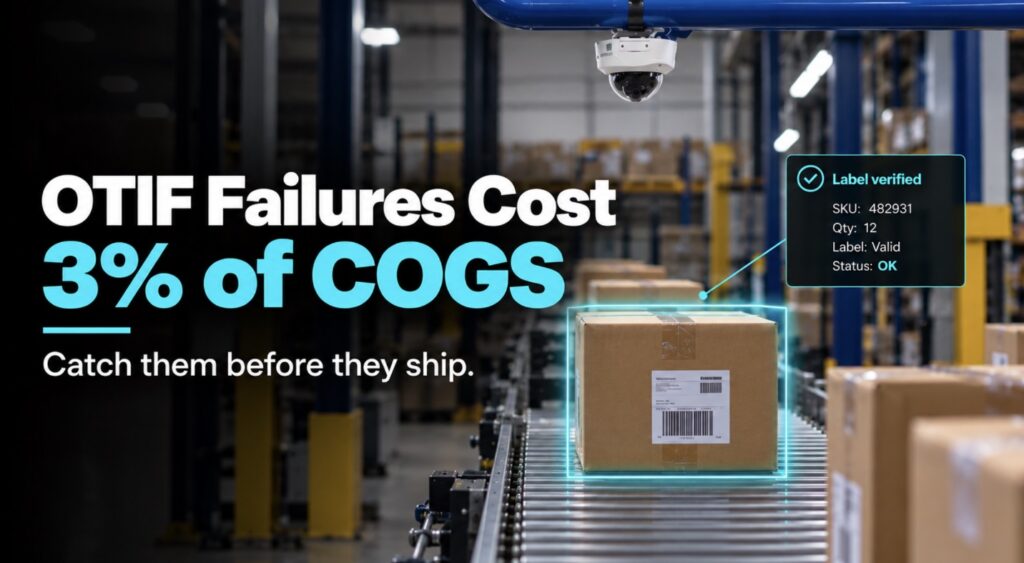
Real-time monitoring catches the failures that actually drive OTIF misses while there’s still time to fix them. Vision AI watching the packing station reads and matches product and label details automatically, catching a barcode that won’t scan or a case-pack count that’s off before the carton is sealed, and mis-picks and short-ships before they leave the building. Coverage at the conveyor catches damage and mis-sorts as shipments move down the line, tracking every item from one station to the next and flagging errors in real time, before they reach the next stop. At every dock door, inbound and outbound, the SKU and shipment are verified automatically and damage is caught before freight is loaded or received. None of this requires someone to be watching the right screen at the right second, since the system is always watching, and the correction happens on the spot instead of showing up as a scorecard hit weeks later.
| Station | What vision AI catches | OTIF failure prevented |
|---|---|---|
| Packing | Product and label details read and matched automatically, so mis-picks, short-ships, a barcode that won’t scan, or a case-pack count that’s off are caught before they leave the building | In-full misses from mis-picks and short-ships, plus labeling errors and carton count discrepancies |
| Conveyor | Damage and mis-sorts as shipments move down the line, with every item tracked from one station to the next | Damage and mis-sort errors carried forward to the dock |
| Dock Door | SKU and shipment verified automatically at every inbound and outbound door, with damage caught before freight is loaded or received | Shipment mismatches and damage before they reach the retailer |
From reactive dispute to proactive prevention
Most compliance teams are set up to respond to OTIF misses after they’ve already happened, disputing the chargebacks that look wrong and absorbing the rest. That recovers real money, but it treats the miss as the problem instead of treating it as evidence of a problem that happened earlier, on the floor, unwatched. Arvist customers have avoided up to $1M in non-compliance fines by closing that gap, catching the ASN, labeling, and configuration errors that drive OTIF failures before a shipment ever ships, instead of arguing about them after the fact. Reactive dispute after an OTIF miss, compared to floor-level errors caught before the shipment ships
Frequently asked questions
What is OTIF in retail supply chains? OTIF stands for On-Time In-Full, a retail compliance metric that measures whether a shipment arrived within its required delivery window and contained the complete ordered quantity. Both conditions must be met for the shipment to count as compliant.
What causes most OTIF failures? OTIF failures commonly start in the warehouse, before the shipment ever leaves. A mis-pick or short-ship, a carton count that doesn’t match the purchase order, an incorrect label, a pallet built to the wrong configuration, or an advance ship notice that is late or inaccurate can each turn a shipment non-compliant. Transit delays play a part too, but many of the errors behind an OTIF miss are decided on the floor.
Are OTIF chargebacks and compliance fines the same thing? Not exactly, though the terms are often used interchangeably. A chargeback is a deduction taken directly off a specific invoice to recover the cost of one shipment’s error. A compliance fine is more often a flat-rate or percentage-based penalty, like Walmart’s 3% of cost of goods on non-compliant cases, charged for missing the broader OTIF threshold over time rather than one shipment’s mistake.
How much does OTIF non-compliance actually cost? Costs vary by retailer, but survey data on chargeback exposure specifically puts cumulative cost at 2% to 10% of total revenue for vendors who aren’t actively managing compliance, with separate compliance fines like Walmart’s 3% of cost of goods penalty adding further cost on top.
Can warehouse technology prevent OTIF failures before shipment? Yes. Monitoring packing, staging, and outbound stations in real time makes it possible to catch the ASN, labeling, and configuration errors that drive OTIF misses before a shipment leaves, rather than disputing the resulting chargeback or fine weeks later.
What’s the difference between an OTIF failure and a freight claim? An OTIF failure is a compliance miss tied to delivery timing or order completeness. A freight claim is a dispute over physical loss or damage that occurred during transit. Both often trace back to the same underlying gap, a lack of evidence from the moment something went wrong, even though they get resolved through different processes.