
What Is AI in Logistics and Supply Chain, Really?
Type “AI in logistics” into a search bar and you’ll get a thousand versions of the same article. Autonomous everything, predictive this, hyper-personalized that. Vague enough to be true of any technology, specific enough to sound like it means something.
It doesn’t, mostly. And if you run a warehouse, you already know it doesn’t, because you’ve sat through the sales pitches.
What gets lost in all that language: AI in a warehouse isn’t one technology doing one thing. It’s a category, and most of what’s inside that category is still theoretical, still expensive, or still months from your dock door. But a piece of it isn’t theoretical at all. It’s running right now, on cameras that are already in your warehouse, catching problems your team can’t catch at the speed your operation runs at.
In this article:
° What “AI in logistics” actually covers, and why the term hides more than it explains
° Why warehouses are turning to it now, not five years from now
° What’s working in warehouses today versus what’s still a slide deck
° Where vision AI fits into quality control and safety, in detail
° The real tradeoffs, and what to ask before you buy any of it
What Is AI in Logistics and Supply Chain?
It’s not one thing. That’s the first problem with the term. “AI in logistics” gets used to describe everything from demand forecasting models to routing algorithms to camera systems on a dock door, and those things have almost nothing in common except the label. Some of them are mature and running in production warehouses today. Some of them are a slide in a Series A pitch deck.
Lumping all of it together is exactly how a narrow, working capability, camera-based inspection at a dock door, gets stretched into a story about total operational transformation. It’s an easy mistake to make. The underlying technologies really are related, even when their maturity levels aren’t, so the broad framing isn’t wrong so much as it’s incomplete.
Broadly, the category breaks into a few buckets. Predictive and planning tools: demand forecasting, network design, dynamic routing. Robotics and physical automation: autonomous mobile robots, robotic picking arms, automated storage and retrieval systems. And perception systems: cameras and sensors paired with machine learning that watch what’s actually happening on the floor and flag when it doesn’t match what’s supposed to happen. Each bucket has a different maturity curve, a different price tag, and a different answer to “does this actually work today.”
Why Warehouses Are Turning to AI Now
Nothing about warehouse operations got easier over the last few years. Labor markets stayed tight. Customer expectations for speed and accuracy kept climbing. Margins on the operator side kept shrinking while the cost of getting something wrong, a missed shipment, a safety incident, a bad claim, kept climbing right alongside them.
Traditional systems weren’t built for that combination. A WMS tells you what should have happened. It doesn’t tell you what actually happened on the dock at 4pm on a Friday when three trucks showed up at once and the crew was short two people. That gap between what the system assumes and what the floor actually did is where most of the expensive problems live, and it’s a gap that adding more manual checks doesn’t close, because manual checks are exactly the thing that gets abbreviated under pressure.
That’s the real reason perception-based AI, cameras that watch continuously and don’t blink, has moved from novelty to adoption curve faster than most other categories in this space. It’s not solving a hypothetical problem, it’s solving the one every operator already has.
How Much of This Is Actually Being Adopted?
More than the skeptics think, less than the vendors claim. In the 2023 Gartner Supply Chain Technology User Wants and Needs Survey, nearly 20% of respondents said they’d already adopted AI-enabled vision systems. Gartner projects that by 2027, half of companies running warehouse operations will be using them instead of manual scanning for cycle counting.
The pace is picking up more broadly too. Material Handling 24/7’s 2026 Software & Automation Outlook Survey found that 26% of respondents said they’re now using AI, up from 19% just a year earlier.
Those numbers are about vision systems specifically. They’re not describing the fully autonomous, everything-connected warehouse that most AI marketing implies is one budget cycle away. That warehouse mostly doesn’t exist yet. What does exist, in a growing number of facilities right now, is a narrower and more useful thing: continuous visual verification at the points where errors truly originate.
What’s Actually Working in Warehouses Right Now
Vision AI. Cameras paired with machine learning models trained to recognize specific problems, deployed at the points in a warehouse where things go wrong: receiving, putaway, packing stations, conveyors, outbound docks. This isn’t speculative, it’s a camera feed and a trained model running continuously, flagging what a person would flag if that person never got pulled onto another task or never missed a frame.
Quality Control
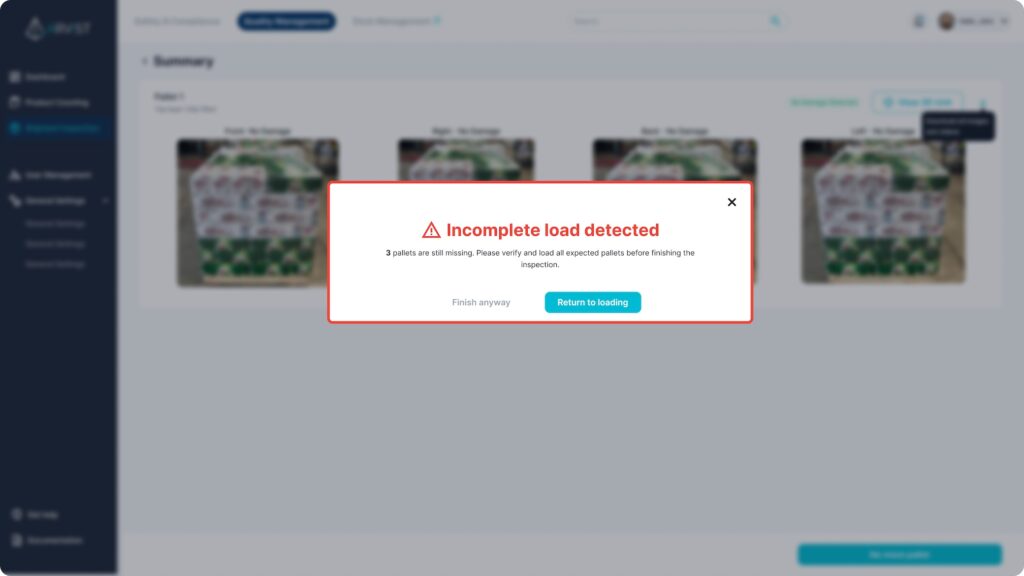
This is the clearest example, because the problem it solves is so specific. A camera at a dock door can read a label and check it against the WMS in real time. It can flag a crushed pallet corner before that pallet leaves the building. It can catch a mis-load while the truck is still sitting at the door, instead of three days later when the customer calls and someone has to reconstruct what happened from memory and a paper BOL.
Catching the error matters, but timing is where the real value sits. A shortage caught at the dock costs you a re-pick. The same shortage caught three days later, after it’s shipped, costs you a claim, a customer service escalation, a chargeback, and possibly a dent in your OTIF score with a retail partner who doesn’t care why it happened. Timing is most of the economics here.
Safety and Compliance
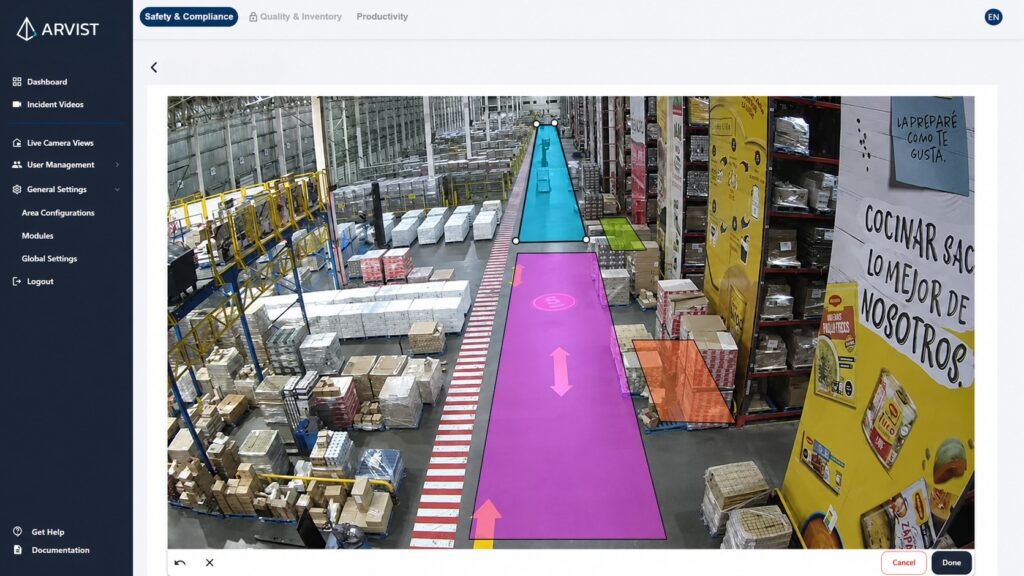
Same logic, different target. PPE gaps, unsafe forklift behavior, someone in a restricted zone without a badge, unsafe lifting posture at a pack station. None of it is glamorous. It’s a second set of eyes running the same shift the floor team is running, catching what’s easy to miss when someone is managing five things at once.
The value here compounds differently than QC does. A missed safety event doesn’t usually cost you money on the spot. It costs you an incident, eventually, and incidents are expensive in ways that don’t show up until after they happen: workers’ comp claims, lost workdays, the operational disruption of an investigation, the compliance exposure if a regulator gets involved. Continuous monitoring doesn’t eliminate risk. It catches the pattern, a specific dock door, a specific shift, a specific piece of equipment, before it becomes an incident report.
Is AI in Logistics Overhyped?
Here’s the BIG question and yes, parts of it is. Fully autonomous warehouses with no human decision-making anywhere in the loop are not a 2026 reality for the overwhelming majority of operators. Predictive routing that accounts for geopolitical shifts and weather in real time sounds compelling in a keynote and is a genuinely hard problem most vendors, AI companies included, haven’t solved at production scale. If someone’s promising you a fully autonomous facility on a near-term timeline, ask for a customer reference doing it today, not a mockup.
The honest version of AI adoption in a warehouse looks less like a leap and more like a series of specific, bounded deployments. Inbound quality checks first, then outbound, and then safety monitoring on the floor. Each one is real, each one is measurable, and none of them require rebuilding your operation from scratch.
That’s a less exciting pitch. It also happens to be true.
What Should You Ask Before You Buy Any of This?
Is this solving a problem you can name, or a problem the vendor named for you? Does it work with the cameras and systems you already have, or does it require ripping out your infrastructure? Can they show you a live customer, not a pilot, not a mockup, running this today? What happens after it flags something, does a person still make the call, or is the system making decisions nobody signed off on?
Ask how long implementation actually takes, in weeks, from a real customer, not a sales one-pager. Ask what happens to the video and data the system collects, who can access it, and how long it’s retained. Ask what the system doesn’t catch yet, because any vendor who claims zero gaps is telling you something about their honesty, not their product.
If a vendor can’t answer those cleanly, the AI story is doing more work than the product is.
What Are the Real Tradeoffs?
Cost is real, but it’s not what people assume. Custom-built AI or warehouse robotics can mean serious upfront investment, new hardware, integration work, ongoing maintenance. Vision AI platforms that work with cameras you already have are a different math entirely, because the infrastructure cost is mostly already sunk. The delta is software and setup, not a construction project.
Data privacy is a legitimate question, not a box to check. Any system built on visual data needs a clear answer for how that footage is stored, who can see it, how long it’s kept, and what it’s used for. If the answer is vague, that’s the answer.
Workforce concern is the one that gets waved away too fast. People hear “AI is watching the floor” and they hear “AI is replacing me.” The honest answer is that the systems worth deploying are built to catch what people can’t catch at scale, not to replace the judgment calls people make constantly. That distinction is worth saying out loud to your team before a camera system goes live, not after someone asks why it’s there and finds out secondhand.
Integration complexity is the quiet fourth item nobody puts on the list. A vision system that can’t talk to your WMS is a very expensive set of cameras. Ask about integration depth before you ask about anything else.
Where This Actually Goes
This is less a dramatic shift than a steady expansion: more of the warehouse covered, more categories of error caught earlier, more of the manual verification work handled by something that runs continuously instead of in bursts. That’s not a headline, it’s just what it looks like when a narrow, real capability keeps getting applied to more of the places it fits.
The warehouses that get the most out of this aren’t the ones chasing the most futuristic pitch. They’re the ones that picked one real problem, solved it, measured the result, and expanded from there.
If you want to see what that looks like as a working system instead of a claim on a page, the Arvist Experience Center is a real warehouse in Chicago running vision AI across receiving, putaway, packing, and outbound docks. Come see what’s actually running before you decide what to believe.
AI in Logistics & Supply Chain FAQ
What is vision AI in logistics?
Cameras paired with machine learning models trained to recognize specific warehouse events: label mismatches, damaged pallets, safety violations, misloads. Narrower and more specific than “AI” as a whole.
Is AI actually being used in warehouses today, or is it still mostly hype?
Both, at the same time. Broad claims about fully autonomous facilities are largely aspirational. Vision AI at dock doors and inspection points for quality and safety monitoring is running in production warehouses today.
What’s the difference between AI-powered automation and vision AI?
AI-powered automation covers routing algorithms, demand forecasting, robotics, the whole category. Vision AI is one piece of it: cameras and machine learning monitoring physical conditions and flagging discrepancies in real time.
Do warehouses need new cameras to use vision AI?
Not necessarily. Many vision AI platforms, Arvist included, are built to work with existing camera infrastructure rather than requiring a full hardware overhaul.
What should you be skeptical of when evaluating an AI vendor?
Any claim about full autonomy on a near-term timeline. Any pitch that can’t point to a live production customer. Any answer that dodges what happens to the footage or data being collected.
Can smaller warehouses realistically adopt vision AI?
Yes. Platforms that retrofit into existing cameras lower the barrier to entry significantly compared to custom-built AI or robotics, which makes the case for smaller warehouses stronger than it was even a couple of years ago.
How much of a warehouse can vision AI actually monitor?
More than a single checkpoint. Receiving, putaway, packing stations, conveyors, and outbound docks are all viable deployment points, wherever camera coverage exists or can be added.
How long does it take to implement a vision AI system?
It varies by facility size, camera coverage, and how much bandwidth your own team has to support the rollout. Ask for a specific number of weeks from a reference customer before assuming anything.