You’ve probably heard “agentic AI” a lot lately, mostly in the context of coding tools and consumer software, less often in supply chain. That’s fair. A warehouse floor or a claims desk is a much less forgiving place to test a new idea than a demo, and most of what gets called agentic AI today is still fairly conceptual.
We’ve put agentic AI to work solving a real operational pain in supply chain instead of just talking about it. Here’s exactly how it works inside Arvist Claims Management, and where we drew the line on what it’s allowed to do on its own.
In this article:
° Why OS&D claims quietly become a bigger drain than the claims themselves
° What Arvist Claims Management is and how it connects to inspection evidence Arvist already captures
° What happens the moment a claim comes in, and the role the Arvist Claims AI agent plays
° Where the “agentic” part actually lives, and where a person still makes the call
° What this means if you’re still fighting the evidence search and the paperwork
Why do OS&D claims cost 3PLs so much?
Talk to any 3PL for long enough and OS&D claims come up, shorthand for Over, Short & Damaged. A consignee receives a shipment, finds it short a pallet or damaged in transit, and files a claim against the 3PL that shipped it. The 3PL then has two problems, and they’re different problems.
The first is evidentiary. Did the shipment actually leave the warehouse short or damaged, or did that happen later, in the carrier’s hands? Answering that means digging through receiving records, dispatch logs, and whatever photos exist, a manual search that’s slow even when it works, and often doesn’t turn up an answer at all. Without proof, most 3PLs simply absorb the cost.
The second is operational. Once a claim is open, it has to be worked. Deadlines to track, a consignee to respond to, a carrier to loop in, internal approvals to chase. In our conversations with clients, this second problem was consistently the bigger drain: managing what happens next, not solving the mystery of what happened.
What is Arvist Claims Management?
Arvist’s core platform already runs vision AI at warehouse quality stations, using cameras that inspect pallets and loads as they ship, checking counts, damage, and load accuracy against warehouse system data in real time. That inspection record was always being generated. It just wasn’t connected to the claims process that needed it most.
That gap is what Arvist Claims Management closes, a new addition to the Arvist QC platform, built directly on the inspection data it already captures. When a claim comes in, as a PDF, an email, or logged directly, the Arvist Claims AI agent reads it, matches it against the shipment it refers to, and pulls the inspection evidence that already exists for that load. From there, it builds an assessment: is the claim supported by the evidence, or does it point the other way? If a dispute is warranted, the agent drafts the letter, grounded in the actual evidence chain rather than a template. Once a response goes out, it tracks the claim through to resolution, deadlines, follow-ups, replies, the way a well-organized claims desk would, except it never forgets or lets something slip.
It’s live today, already working real claims for Arvist customers.
Where does the “agentic” part actually live?
This is the part most companies claiming agentic AI skip, because it’s the least flattering to talk about: not every step in this workflow uses an AI agent, and the ones that do aren’t left to run unsupervised.
The Arvist Claims AI agent uses AI throughout this workflow, reading incoming claim documents and later drafting dispute letters. But the real value sits in between: tracing evidence and triaging what it means.
Finding the evidence. The genuinely agentic piece is evidence retrieval and assessment. Claims rarely arrive with a clean, unambiguous shipment reference. Sometimes a claim has to be matched using a combination of partial identifiers, and the right evidence has to be tracked down across several records before a determination can be made. That’s a real search problem, and it’s the one place in the workflow where the system runs an actual multi-step process: look, evaluate, look again, until it either finds a confident match or concludes it can’t. If it can’t, it stops and hands the claim to a person, rather than guessing its way to an answer.
What makes AI “agentic?”
Most AI features today are single-shot: ask a question, get an answer, done. An agent is different. It can take a sequence of steps on its own, calling tools between each one, checking what it just found, and deciding what to do next, until it reaches a confident answer or recognizes it can’t.
Under the hood, this runs as a bounded loop: the model repeatedly calls tools, often through a standard connection layer like MCP (Model Context Protocol), gathering information a step at a time, until it’s confident or hits its limit.
How Arvist implemented this.
That loop is exactly what powers evidence tracing inside Arvist Claims Management. Many claims don’t arrive with one clean shipment reference, so the agent works through the identifiers it has, checks each result against what the claim actually asserts, and either builds toward a confident match or concludes it can’t, handing the claim to a person rather than guessing. That decision-making loop, not a clever one-line prompt, is what makes this agentic AI, rather than an AI feature bolted onto a form.
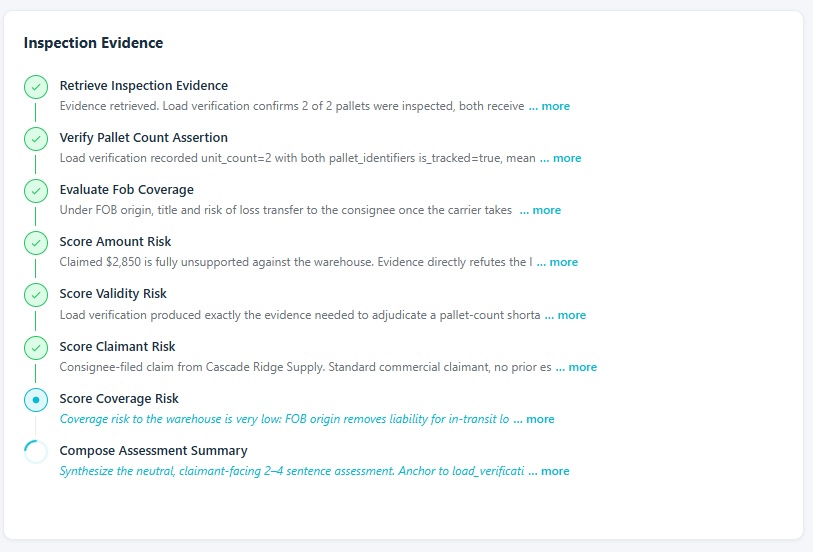
What that looks like in practice: the system retrieves the relevant inspection record, checks it against what was actually claimed, evaluates who’s liable under the shipping terms, then scores several dimensions of risk before writing a plain-language summary, each step visible, in order, as it happens.
Drafting the letter. Drafting the response letter is generation, not extraction, but it’s generation on a short leash. Every factual claim in that letter has to trace back to something the evidence retrieval step actually found. The system isn’t free to write whatever sounds persuasive; it’s constrained to write what the record supports.
Scoring the risk. The risk score attached to every claim, the number that flags how confident the system is and how urgently it needs attention, isn’t something the AI decides. It’s a fixed, weighted calculation. The AI’s job is to gather and classify the inputs; the arithmetic that turns those inputs into a number is the same every time, for every claim, which means it’s explainable and auditable in a way a model’s raw judgment never fully is.
Why doesn’t the AI send anything on its own?
None of this reaches a customer or a carrier without a person approving it first. The system can draft a dispute letter, a request for more information, or an acceptance. A claims handler chooses which one, reviews it, and sends it. We built it that way deliberately.
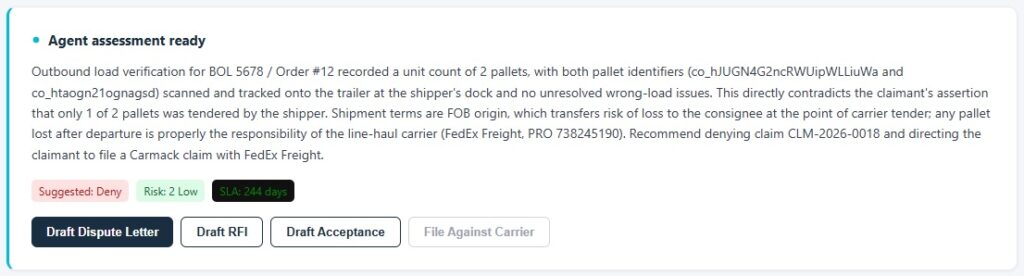
The agent’s output on a completed claim: a plain-language assessment, a recommendation, and a confidence read, followed by the actions a handler can choose from. Filing directly against the carrier is greyed out here, because the shipping terms on this claim don’t support it, a business rule the system enforces rather than leaves to judgment.
The honest version of “agentic AI” does the slow, evidence-heavy work reliably, while leaving the judgment calls in human hands.
That covers the searching, the drafting, and the tracking, plus every external communication, which never leaves the building without a person’s sign-off. We built it that way because a claims decision has real financial and relationship consequences, and because we’d rather ship something a claims team actually trusts than something that looks impressive in a demo and gets quietly disabled three weeks into production.
That trust also came from listening. Early on, a client pointed out that a claim they were defending against often had a mirror image: a claim they should be filing against their own carrier for the same underlying loss. That single piece of feedback is now shaping the next part of what the Arvist Claims AI agent does: extending the same evidence-first approach to claims filed outward as well as claims defended.
What does this mean if you’re still fighting the evidence search and the paperwork?
If any of this sounds like your week:
° Digging through receiving records and photos, hoping something turns up to prove what actually happened
° Absorbing claims you probably could have disputed, because proving otherwise takes longer than the claim is worth
° Tracking deadlines and follow-ups across email threads and spreadsheets, hoping nothing slips
That’s the exact gap Arvist Claims Management was built to close: agentic AI put to work on the two things that actually cost you time, finding the evidence, and running the process around it.
Agentic AI is only as good as the operational pain it removes. This is what removing it looks like.
A few questions we hear a lot:
Does the agent ever send anything without a person reviewing it first? No. The system can draft a dispute letter, a request for more information, or an acceptance, but a claims handler always chooses which one, reviews it, and sends it.
What actually makes this “agentic” instead of a regular AI feature? The evidence search. Claims rarely arrive with a clean, unambiguous shipment reference, so the agent runs a real multi-step loop: look, evaluate, look again, until it finds a confident match or concludes it can’t and hands the claim to a person.
Is the risk score something the AI decides? No. It’s a fixed, weighted calculation. The AI gathers and classifies the inputs; the arithmetic that turns those inputs into a number is the same every time, which keeps it explainable and auditable.
Does this only help us defend against claims, or can we use it to file them too? Both, and that’s expanding. A client pointed out that a claim they were defending against often had a mirror image, a claim they should be filing against their own carrier. That’s now shaping the next part of what the Claims AI agent does.
See it for yourself
We could keep describing the loop, but it’s easier to see than explain. Visit the Claims Management page for a full walkthrough, or come see the platform live at the Arvist Experience Center in Chicago.
Book a visit and see what your claims desk has been missing. Or get in touch for a walkthrough.