Short Ships, Chargebacks, and Disputes: The Trifecta Draining Your DC’s Margins
The gap in outbound load verification is quieter than you’d expect — and more expensive than most DC operations realize. Here’s what’s actually happening at the dock, and how modern load verification closes it before the truck rolls out.
In this article:
° Why short ships, mis-loads, and load damage keep happening despite your team’s best efforts
° What each failure mode actually costs downstream and why the timing of detection changes everything
° Why manual verification can’t hold consistently at scale, even with a great team
° How automated load verification closes the gap in real time, before errors leave the building
° What changes operationally when the dock becomes a genuine control point instead of a throughput risk
The Real Cost of Outbound Shipping Errors
Every distribution center has a version of the same story. A load ships, the retailer receives it, and three days later your customer service team is looking at a chargeback: wrong quantity, damaged pallet, missing SKU. Your team pulls the paperwork, someone checked a box, the truck left on time. Nothing looks wrong on your end, but the money is already gone, the dispute clock is running, and someone is now spending their afternoon reconstructing what happened at a dock door three days ago.
Most operations leaders we talk to already know this isn’t a one-time thing. It’s a pattern — one that runs quietly in the background across hundreds of loads, rarely dramatic enough to force a reckoning, but adding up to six figures in margin loss every year. The frustrating part is that it usually has nothing to do with how hard the team is working. The team is working the process they have. The process just has gaps, and gaps get exploited on the days when throughput pressure is highest and the margin for error is thinnest.
The Three Outbound Errors That Cost DCs the Most
There are three places where those gaps tend to do the most damage, and they tend to show up together.
Short Ships and Over-Ships
Short-shipping is the most common. A pallet gets loaded with 47 units when the order called for 50, nobody catches it at the dock, and the discrepancy lands in your customer’s receiving system hours or days later. What follows is a chargeback, a dispute process, and a conversation that costs more in management time than the missing units ever would have. Over-ships are the mirror image — you send more than was ordered, absorb the cost, and often don’t get credit for it on either end. Both create the same underlying problem: the load that left your dock didn’t match the order, and by the time anyone knew that, the window to fix it cheaply had already closed.
Mis-Loads and Mis-Docks
Mis-loads are the kind of error that seems like it shouldn’t be possible until it happens to you, and when it does, the downstream consequences are disproportionate to the original mistake. The right customer is short. The wrong customer has product they didn’t order. Both are calling you at the same time, and the resolution requires coordinating across carriers, customers, and internal teams in a way that burns through labor hours that were never budgeted for this. In multi-door facilities running at any real volume, mis-docks (loading the right product through the wrong door entirely) add another layer, because the pressure of the dock rarely allows the kind of double-checking that would catch it before the truck moves.
Load Damage
Load damage sits in its own category because it’s the failure mode most likely to generate a dispute you can’t win. A crushed corner, an unstable stack, broken stretch wrap — these things happen during loading and go undetected because nobody is in a position to look for them in the 30 seconds a pallet spends moving through the dock door. The damage travels with the load, the customer receives it and flags it, and now you’re in a conversation about when it happened and who’s responsible. Without time-stamped visual documentation of what left your dock in what condition, that conversation defaults to whoever has better records. More often than not, that isn’t the shipper.
It’s worth noting that the same dynamic plays out on the inbound side — shipments arriving damaged or short that clear the dock without proper inspection and surface as inventory discrepancies days later. We covered how that gap compounds over time in our piece on automated shipment inspection, and the root cause is identical: a verification process that breaks down under exactly the conditions it’s needed most.
Why Manual Load Verification Breaks Down at the Dock
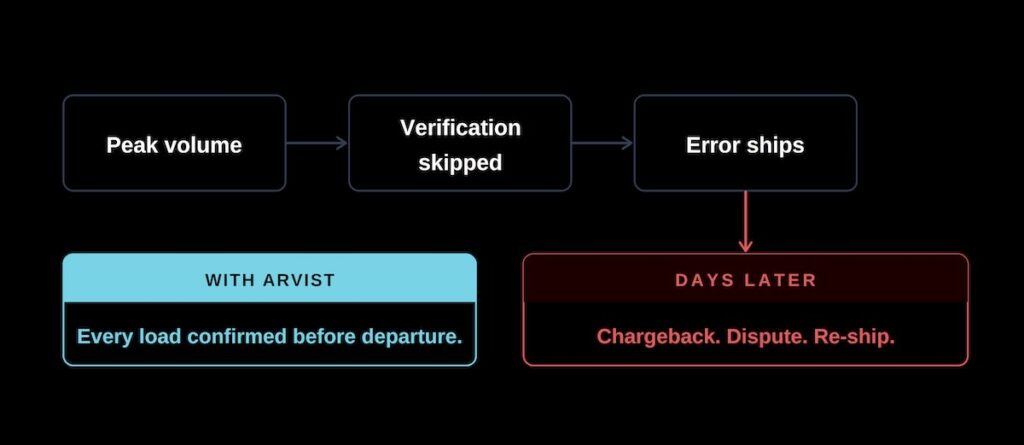
What makes all three of these failure modes so persistent is that they share the same root cause: a verification process that depends on human attention at exactly the moment when human attention is most likely to be stretched thin. Manual verification isn’t unreliable because the people doing it are careless. It’s unreliable because it was never designed to hold consistently at scale, under pressure, across every shift, every lane, and every load. On a light day with a full crew and straightforward shipments, it works well enough. On the days when three trucks arrive in the same window and the team is short-staffed and the clock is not interested in any of that, which is to say, on the days that matter most — verification is exactly the step that gets abbreviated.
The downstream effects of that abbreviation are familiar to anyone who has managed a busy DC through a rough stretch. Wrong loads discovered after departure mean emergency re-ships and carrier coordination that consumes hours of management time and produces nothing for the customer except a delay. Incomplete shipments that reach the retailer trigger chargebacks that are nearly impossible to fight without documentation of what actually left the dock. Damaged goods that were loaded without detection travel the full distance to the customer before the problem surfaces, turning what could have been a two-minute catch at the dock into a return, a complaint, and a customer relationship that takes months to repair.
The answer to this isn’t more clipboards or additional sign-off steps. More manual oversight runs into the same ceiling that manual verification always runs into: it depends on attention and availability, and adding more of either doesn’t change the structural gap. What closes the gap is a system that doesn’t depend on either.
How Automated Load Verification Works at the Dock Door
Camera-based systems like Arvist deploy directly at the dock door and provide complete visual coverage of every pallet as it moves through — reading labels, validating SKUs and quantities, detecting visible damage, and cross-referencing everything against the WMS in real time, before the truck moves. When something doesn’t match, the system flags it while there’s still time to do something about it. The window to intervene hasn’t closed and the error doesn’t ship. What could have become a three-day dispute gets resolved in two minutes at the dock, which is the only version of that resolution that doesn’t cost you something.
Every inspection is fully documented — high-resolution images and video linked to the corresponding shipment, dock door, and timestamp — so when an OSD claim arrives, the evidence is ready in minutes. When a carrier disputes the condition of a load, there’s objective documentation of what left the dock. When a customer insists a shipment arrived incomplete, there’s a timestamped record of every pallet that moved through the door. Disputes that previously required extended negotiation or split-cost concessions can now be resolved quickly and with confidence, because one side has a clear visual record and the other doesn’t.
Arvist integrates directly with your existing WMS and TMS, which means real-time status flows to the teams that need it without adding a separate system to manage. Most installations are fully operational within a month, and dock door stations typically connect to existing network infrastructure in about a day.
ROI of Automated Load Verification: What to Expect
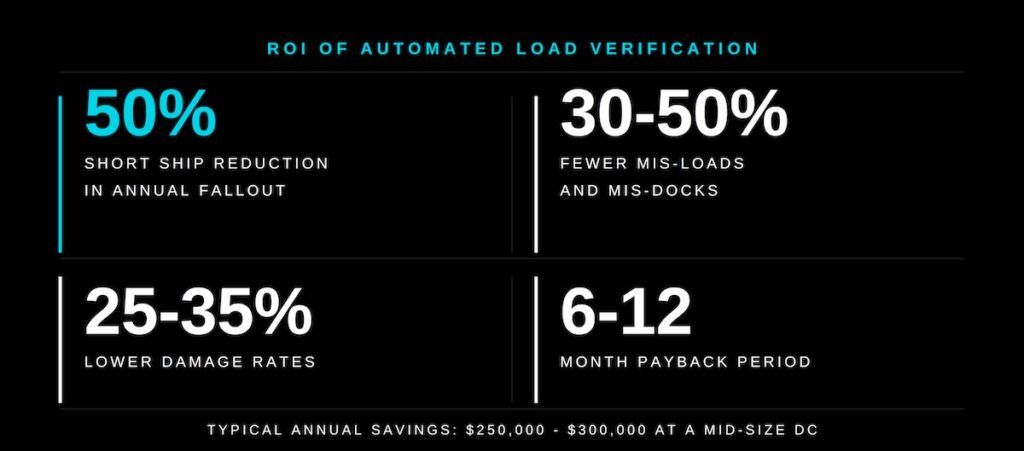
Mid-size DCs implementing automated load verification consistently see short and over-ship fallout drop by around 50%, mis-loads and mis-docks fall by 30 to 50%, and load damage rates reduce by 25 to 35%. Most reach payback within six to twelve months, with typical annual savings in the range of $250,000 to $300,000 for a mid-size operation.
But the number that doesn’t show up in a spreadsheet is the one that might matter most: the cumulative effect of a process that holds consistently, across every shift and every load, without requiring the dock to have a perfect day in order to perform like one. Every mislabeled pallet caught at the door is a carrier dispute that never opens. Every incomplete shipment flagged before departure is a customer complaint that never arrives. Every piece of damage detected before loading is a return that never has to be processed. The benefit isn’t only in the individual errors prevented — it’s in what happens to an operation when the structural gap that was generating those errors gets closed at its source.
If that gap has been costing you, it doesn’t have to keep doing that.
Want to see how it works in practice? Visit Load Verification for a closer look, or book a visit to the Arvist Experience Center in Chicago — it’s running on an actual warehouse floor, not a demo stage.