The Shipment That Looked Fine at the Dock (Until It Wasn’t)
How missed dock inspections silently damage inventory accuracy, fulfillment, and supplier relationships — and how Arvist’s new Automated Shipment Inspection feature closes the gap for good.
In this article:
- Why even well-run warehouse teams miss inspections — and why it’s rarely human error
- What a missed inspection actually costs downstream: from inventory inaccuracies to customer complaints
- The journey from fully manual inspection to Arvist’s manual mode to full automation
- How Arvist’s new Automated Shipment Inspection feature removes the dependency on human initiation entirely
- What the shift from reactive firefighting to proactive prevention looks like in practice
If you’ve ever worked a busy dock, you already know the feeling — a truck pulls in, the clock is ticking, the team is stretched thin, and somewhere in the controlled chaos of an ordinary Tuesday afternoon, a pallet slips through without inspection, or a truck rolls out missing a load that was never supposed to leave without it. Nobody meant for it to happen, and in the moment, nobody even notices. The dock keeps moving, the next truck pulls in, and the day carries on like nothing happened. Because as far as anyone at the dock is concerned, nothing did.
The problem with missed inspections is that they’re invisible until they’re not. They don’t announce themselves at the receiving door, they surface three days later when fulfillment flags a discrepancy, or two weeks later when a cycle count turns up numbers that don’t match the system, or worse, when a customer receives the wrong item and someone has to spend the better part of an afternoon tracing the thread back to a single shipment that wasn’t properly checked on a day when the dock was two people short and everyone was doing their best. By the time you know something went wrong, you’re already deep into the cost of fixing it, and the original mistake is long buried under everything that came after it.
That gap, between what happens at the dock and what it costs you downstream, is the problem that most warehouse operations have learned to live with rather than solve. Not because they don’t care, and not because their teams aren’t good at their jobs, but because the tools available for managing dock inspection were never really designed to close it. They were designed to document what happened, after the fact, when someone remembered to document it. Which, it turns out, is a very different thing.
Arvist’s new Automated Shipment Inspection feature was built to close that gap for good. But to understand why it’s a meaningfully different kind of solution than what came before, it helps to understand the full picture of where most warehouses have been — and why the standard fixes haven’t been enough.
Before Arvist: Paper, People, and a Lot of Hope
Before digital inspection systems entered the picture, everything at the dock door ran on printed manifests, clipboards, the occasional barcode scanner if the operation was well-resourced, and a whole lot of physical eyeballing, hand-counting, and cross-referencing paperwork against what was actually sitting on the dock. For straightforward shipments on quiet days with a full team, it worked well enough. The problem was that warehouses aren’t defined by their quiet days, they’re defined by their hard ones.
When volume spiked, inspections got rushed or skipped entirely. When the team was short-staffed, the people who were there prioritized getting shipments moved over getting them documented. When a truck arrived late and the dock was already backed up, something had to give, and more often than not it was the inspection. There was no enforcement layer beneath any of this — nothing to catch what tired or overextended humans missed, nothing to flag that a shipment had cleared the dock without being properly verified. Just process, people, and the shared expectation that everyone would follow through every time, under any conditions.
That expectation was always unrealistic, and the downstream fallout was expensive and far-reaching. Incorrect inventory received into the system created discrepancies that took hours to untangle. Short shipments discovered days after arrival triggered supplier disputes that damaged relationships and consumed management time. Damaged goods that cleared the dock unnoticed ended up in fulfillment, then in customer orders, then in return requests and complaints that eroded trust that took months to rebuild. Emergency cycle counts pulled labor away from productive work to clean up messes that a better front-end process could have prevented. And underneath all of it, a constant low-grade drain on operational capacity as teams spent their energy investigating yesterday’s problems instead of running today’s operation.
Arvist’s Manual Inspection Mode: Progress, With One Catch
Arvist’s manual inspection mode changed the picture significantly. Warehouses gained structured digital workflows that guided workers through each step of the inspection process, reliable documentation that created a real audit trail, and visibility into dock activity that managers had never had before. Instead of hoping the paperwork was accurate, they could actually see what had been inspected, when, and by whom, and when something did go wrong, tracing it back became a matter of minutes rather than a guessing game.
For operations that had been running entirely on paper, that was a genuine transformation. But the fundamental vulnerability in the process hadn’t been eliminated, it had just been moved. The system still required a human to initiate every inspection, for every shipment, every time it arrived. If an operator got pulled away to handle something else, was managing two situations at once during a busy stretch, or simply lost track of a shipment in the flow of a hectic shift, the shipment could move through the dock without ever entering the system. The digital workflow only ran if someone started it, which meant the process was still only as reliable as the people executing it under whatever conditions the dock happened to be generating that day.
In practice, this meant the same downstream problems could still occur, just less frequently and with a clearer paper trail when they did. Which is a real improvement, but not the same as a solution. If you’re an operations manager looking at inventory discrepancies that keep appearing without a clear pattern, the fact that it’s happening less often doesn’t tell you much about when it’s going to happen next or how to stop it.
The Last Manual Step Gets Automated
Arvist’s new Automated Shipment Inspection feature removes the initiation problem at its root. The system now detects incoming shipments and triggers inspections automatically — no operator needs to remember to start one, no workflow needs to be manually opened, and no shipment can clear the dock without the system enforcing the appropriate process. Coverage becomes structural rather than behavioral, which means it holds up on the busiest days, the most understaffed shifts, and the most chaotic afternoons — exactly when every previous version of this process was most likely to fail.
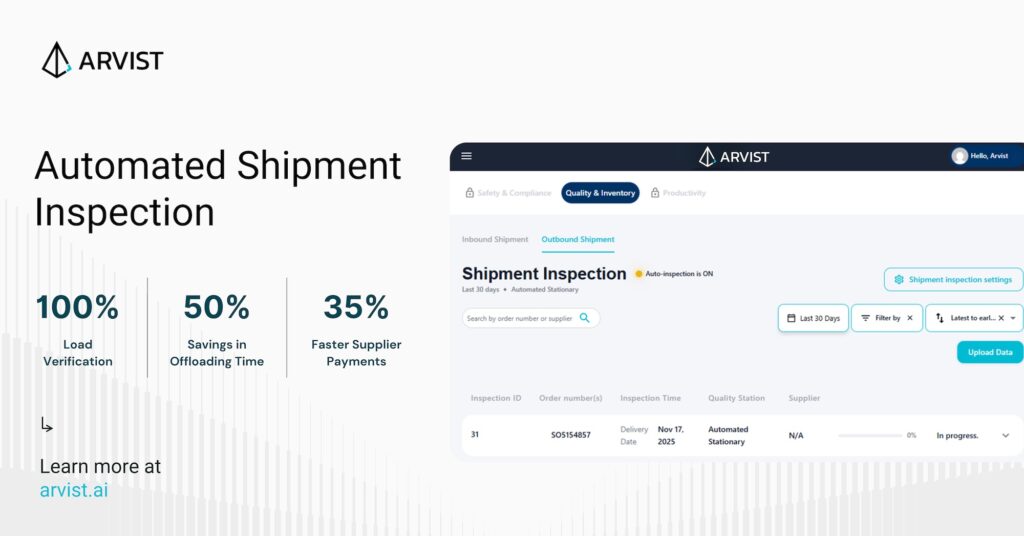
For operators on the floor, the day-to-day experience is meaningfully different. Instead of managing the inspection process, deciding when to initiate it, tracking which shipments have been checked, manually moving through workflow steps and closing things out, they simply respond to what the system surfaces. The cognitive overhead of process management disappears, replaced by clear, system-guided tasks that tell them exactly what needs to happen and when. In an environment where attention is a limited resource and the cost of a distraction can ripple forward for days, that’s not a small thing.
The consistency gains are just as significant as the time savings. Manual inspections were inherently variable — how thorough they were, how long they took, and whether they happened at all depended heavily on who was working, how busy the dock was, and what kind of shift it had been. That variability is where risk lived. Automated inspection eliminates it. Every shipment goes through the same process with the same rigor regardless of external conditions, and every completed inspection leaves the same clear, timestamped record. The process doesn’t have good days and bad days anymore — it simply holds, regardless of what the shift looks like. But automation at the dock doesn’t stop at what comes in, the same gap exists on the other side of the door, and it carries the same risk.
Load Verification: The Outbound Problem That’s Just as Expensive
In a traditional operation, verifying a load before a truck departs falls on the forklift driver. That means manually scanning the barcode on each pallet or item, cross-referencing it against the manifest, and flagging discrepancies before the truck rolls out. On a quiet day with a straightforward load, it’s manageable. On a busy afternoon when the driver is moving between multiple docks, running behind schedule, and pulling from a warehouse that’s operating at full stretch, it’s exactly the kind of step that gets abbreviated or skipped — not out of carelessness, but because something had to give and the truck was waiting.
The result is a familiar one: the wrong load goes out, or a load goes out incomplete, and nobody finds out until the customer does.
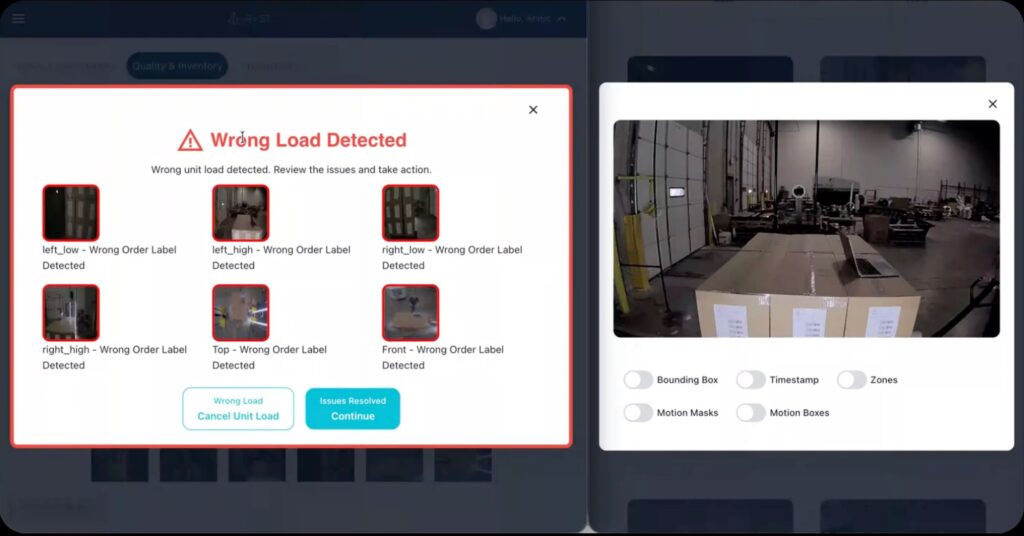
Arvist’s Automated Load Verification changes that calculus on both fronts. On the efficiency side, the system eliminates the need for forklift drivers to manually scan individual barcodes per load — a process that adds meaningful time to every departure, multiplied across every truck that moves through the dock in a day. What was a manual, labor-intensive step becomes a system-enforced verification that runs in the background without pulling the driver out of the flow of their work.
On the accuracy side, the system doesn’t rely on a driver catching the discrepancy, it catches it automatically, flagging wrong items or missing loads before the truck departs rather than after. That’s the difference between a two-minute fix at the dock and a much more expensive problem once the truck is already down the road. Wrong loads don’t leave. Missing loads don’t go unnoticed. And the operational cost of a misdirected or incomplete shipment, the customer complaint, the emergency re-ship, the supplier friction, the wasted carrier capacity — doesn’t get added to the tab in the first place.
The Hidden Cost Nobody Talks About: Inventory Accuracy
Picture this: a cycle count comes back wrong, fulfillment ships an item that was supposed to be out of stock, or a reorder fires on inventory that was never actually received. Nobody can immediately explain why. The investigation takes hours, the finger-pointing takes longer, and the origin of the problem, when someone finally traces it back, is a shipment that moved through the dock uninspected three weeks ago and fed bad data into the system before anyone knew it was bad. That’s what inconsistent dock inspection actually costs, and it’s one of the most underappreciated consequences of the problem because by the time it surfaces, the connection to the dock is nearly invisible.
Cycle counts become longer and more complicated because the underlying data can’t be trusted. Reorder points get miscalculated because the inventory numbers they’re based on are off. Fulfillment errors increase because the system believes something is in stock that isn’t, or in a condition it isn’t. Each of these problems has its own downstream cost, and most of them trace back to the same root cause — a gap at the dock that let inaccurate data into the system in the first place.
Automated inspection doesn’t just prevent missed inspections — it protects the integrity of the inventory data that every other part of the operation depends on. When every shipment is verified against the same standards every time, the information that enters the system is reliable, and reliable information is the foundation that everything else is built on.
What Changes When Problems Stop Reaching Fulfillment
The efficiency gains from automated inspection are real, but the deeper value is harder to quantify and more important to understand. It’s the difference between a warehouse operation that reacts to problems and one that structurally prevents them from occurring in the first place.
In a reactive operation, problems surface after the fact and get resolved through investigation — someone notices the discrepancy, traces it back through the records, figures out where the process broke down, and moves on until the next one appears. That cycle is exhausting, absorbs enormous amounts of labor and management attention, and never quite gets to the root of the issue because the root of the issue is structural. The process has a gap in it, and gaps get exploited on bad days, which means the problems keep coming.
Automated inspection changes that dynamic at the source. Shipments don’t slip through because there is no longer a gap to slip through — the system enforces coverage regardless of human factors. Problems that used to surface in fulfillment get caught at the dock, when they’re still cheap and simple to fix, before they’ve traveled further along the chain and picked up additional costs along the way. The investigation cycles get shorter because there’s less to investigate. The firefighting slows down because there are fewer fires — not because the team got better at fighting them, but because fewer fires are starting in the first place.
That shift compounds over time. Every problem prevented at the dock is a problem that doesn’t travel downstream, doesn’t consume labor to investigate, doesn’t damage a supplier relationship or a customer experience, and doesn’t contribute to the slow erosion of inventory accuracy that makes everything else harder to manage. The benefit isn’t just in the individual shipments that get properly inspected — it’s in the cumulative effect of a process that works consistently, every day, without requiring heroic effort from the people running it.
So What Does This Mean for You?
If your receiving process currently depends on an operator remembering to initiate an inspection for every shipment, on every shift, under every possible condition, you have a structural gap — and that gap is costing you in ways that probably aren’t showing up clearly on any single report. The cost is distributed across inventory discrepancies, fulfillment errors, supplier friction, customer complaints, and hours of labor spent investigating problems that started at the dock and traveled downstream before anyone noticed they’d begun.
Automated Shipment Inspection closes that gap by removing the dependency on human initiation entirely. It doesn’t ask your team to be perfect or your process to be followed flawlessly under pressure — it just runs, consistently, in the background, making sure every shipment gets the scrutiny it deserves regardless of what else is happening on the floor. What you get in return is consistent coverage, cleaner inventory data, and the ability to redirect the energy your team has been spending on reactive problem-solving toward the work that actually moves the operation forward.
The dock doesn’t slow down for anyone. Now, your inspection process doesn’t either.